This June I had the tremendous privilege and pleasure of traveling to Rio de Janeiro Brazil for the 8th RAMICS (Research Association on Monetary Innovation and Community and Complementary Currency Systems) conference: Ramics in Rio 2026 – Plurality of Social Currencies: solidarity economy, municipal and community currencies for inclusive and sustainable futures.
Founded at the international biennial conference on community currencies in Salvador da Bahia on 29th November 2015, RAMICS was organized, amongst other goals, to link the inter-related projects of The International Journal of Community Currency Research (IJCCR), the Bibliography of Community Currency Research (cc-literature), and to facilitate the organizing of these biennial conferences which have been taking place since 2011. Several of the founding members have continued to participate in RAMICS’ management committee, including Georgina Gomez (Netherlands) and Jerome Blanc (France).) Professor Eduardo Diniz, FGV, Sao Paolo (Brazil) was the local organizer for this conference, having assumed Co-President role in RAMICS in 2022.
Since its founding, RAMICS has witnessed a variety of whiplash-inducing changes in a variety of relevant political, social, and economic landscapes, many of which were referred to in the presentations and will be reported on in this article.
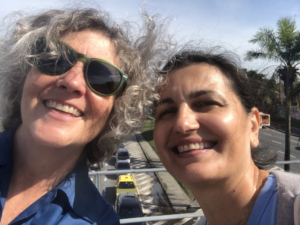
Stephanie Rearick (l) and Rossitsa Tonchev (r)
RAMICS in Rio brought us four keynote panels offered with simultaneous Portuguese/English translation, eighteen workshop sessions featuring 72 presentations, roughly 1/3 in English, 1/3 in Portuguese, and 1/3 with simultaneous translation. Fourteen of the presentations were offered online only (which in my perspective would have been a far less enriching way to participate). In addition, we were offered two days of incredible, learning-packed field trips to nearby currency-related projects. Around 100 people participated in person, with nearly as many presenting.
From among the European participants, we heard from Thomas Siderius of Amsterdam’s Makkie, Ester Barrinaga of Lund University in Sweden, Georgina Gomez, long-time IJCCR and RAMICS leader from Erasmus University in Rotterdam and Nicolas Franka of Belgium-based Monetary Diversity Institute. South American luminaries included Heloisa Primavera, co-founder in 1999 of Argentina’s REDLASES – Latin American Network of Solidarity Socio-Economy, Joaquim Melo, founder of Banco Palmas; the Mayor of the Brazilian city of Santiago, and many more. A full description of the proceedings and list of abstracts are available here.
I went to conference to present The Missing Linking, the paper I’d written on behalf HUMANs (Humans United in Mutual Aid Networks), the global cooperative network I founded. Incidentally, I was the only US-based presenter and one of just two from North America – a refreshing change of pace from what I’m used to. I wrote The Missing Linking with my colleagues Gorazd Norcic, Marcus Petz, and Matt Howard, to document my 30 years’ experience with complementary currencies and other cooperative economic practices, and lay out the road ahead where we experiment more fully with our model. The title refers to my perspective that all of the links that we need in order to create the economy of our dreams, one in service to healthy humans and the planet, already exist. These links include all sorts of practices of sharing and exchange – including but not limited to community currencies – combined with organizational structures, governance models, and work flows. What is missing is the act of linking them together in a functional way.
What I learned at the conference reinforced that perspective: We, as a loosely-connected community of people who seem to believe that community currencies can have a positive impact on society, are still failing to take the action steps required to make it so. But many of the conference presenters and participants readily identified what some of those action steps are, and despite some missed opportunities, that were partly due to the limiting factors of an academic conference format, it becomes clear that the movement for a friendlier economy via complementary currencies is ripe to grow into its potential.
Here I will summarize some of the learnings as they were presented at the conference, and other learnings that presented themselves in the very rich spaces between planned activities, when participants had the opportunity to share their real-life experiences in open dialogue rather than the 1- or 2-way communications of presentations with Q&A.
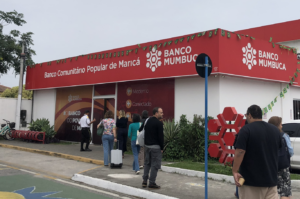
Field trip to Banco Mumbuca
Holding the conference in Brazil offered the rich opportunity to hear from the many diverse complementary currency projects there.
The country’s modern foray into community currencies began in 1998 with the formation of Banco Palmas in a suburb of Fortaleza, to combat high unemployment and poverty.
Initially, Banco Palmas sprang up to meet the pressing need that the community had no bank and no local investment. The bank created a currency that met that need, a friendlier form of money that continues to provide major benefits to its users and their communities.
Now, so-called Solidarity Economy efforts have proliferated throughout the country, with 182 community banks, 14 of which are run by their municipalities. Plus a network of mutual support, 400,000 users in 94 cities, 30,000+ participating businesses, and R$4 billion (ca. 0.7 billion €) worth of exchange in the last 6 years. Now the network is working to institutionalize a regulatory framework and supportive public policy
Banco Palmas is currently launching a much-hyped system whereby members can pay by scanning the palm of their hand. Administrators are very excited about it as people will no longer have to worry about losing passwords, or other complications in access. The new technology also adds an air of futurism and, perhaps, legitimacy. Even if a segment of the population might be uneasy with the use of biometrics, the campaign appears to be breathing new life and excitement into the system.
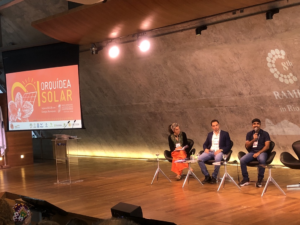
Ester Barrinaga, Santiago Mayor Marcelo Pirú, Daniel Pereira dos Santos of Orquidea Solar
Successes like these dotted the presentation during the conference, but so did some common failings of community currencies, which I will turn to next before coming back to the good news.
Hearing the trajectory of the many stalled or disappointing currency projects presented, I realized that a crux of their problem was their imitation of the dynamics of money-and-business-as-usual. Several projects (e.g. Banco Mumbuca, Amsterdam’s Makkie) identified their members’ demands for a “buyer of last resort,” usually consisting of a large grocery store or a government entity.
Those buyers of last resort often require a conversion from the CC to the respective national money, which then takes the social currency out of circulation and re-creates the conditions where wealth pools in the hands of already-wealthy institutions.
Community currencies tied to or backed by national money also operate with similar issues of scarcity (an administrative body needs to decide how much is issued into circulation or sells it into circulation with the existing scarce national money) and a need to be promoted and managed. Sponsoring municipalities and organizations often determine that the cost is too high both in conventional money and staffing time, and isn’t warranted by the demonstrated benefits (Makkie). Discontinuation of funding often causes the death of the project itself, as was demonstrated starkly in a Cameroon currency project carried out by the German Development Agency and abandoned partway through the experiment, as presented in person by participating German researcher Martina Metzger).
A continual threat is also presented by projects’ dependency on government goodwill. The examples presented by Paola Diaz and other panelists included the case of Argentina’s Trueque, which achieved massive levels of engagement and support during Argentina’s economic collapse in the late 1990’s/early 2000’s, and its demise due to lack of transparency and corruption. Such efforts have become negatively associated with emergencies, while current efforts are stifled by Argentina’s President Milei dismantling of the state, and lack of supportive policies. They are also hampered by a loss of trust, a lack of desire to invest in Argentina, and too much focus on politicians.
In Brazil there is a large dependency on the Presidency and policies of Luiz Inácio Lula da Silva. Participants experienced a period of stagnation under president Bolsonaro, which again reversed with Lula’s re-election. Now several projects appear to be vulnerable due to their reliance on the oil royalties of their local governments which are a large part of the subsidies funneled towards Solidarity Economy projects.
Other papers showed evidence that when outside institutions impose a currency to impact behavior it doesn’t work (e.g. Ecomobicoin, an experiment based at Université Clermont Auvergne, France, to incentivize cycling via blockchain currency payments per km traveled by bicycle), and a few of the presentations seemed to reflect a “blockchain fetishism” by which the current cache of blockchain technologies gets mistaken for special problem-solving powers.
Additional problems identified in the study of the Makkie were the masking rather than challenging exclusion, and a “time is money” attitude creeping into community spaces or, as Michael Marks put it on day 3, currencies relying on existing businesses to carry the burden of making the currency worthwhile.
Finally, many of the currencies represented at the conference are in flux between paper and digital,like Makkie and Banco Arariboia. The results of these nascent experiments remain to be seen. But as Nicolas Franka said in his presentation on Municipal adoption of complementary currencies in Europe, “Going digital to save a currency is like having a baby to save a marriage.”
It would be an oversight to omit mention of the impacts of the pandemic, which many presenters reflected on. Rio itself saw an explosion of community currencies in 2021 when the city passed laws in their favor for pandemic relief.
However, multiple participants also acknowledged that the pandemic decimated their efforts, primarily due to restrictions on assembling, heightened social tensions, habituation to anti-social behaviors, and a decline in overall economic conditions.
As one of the day 2 last session panelists said, “to rebuild is harder than to build.”
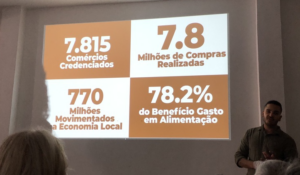
Solidarity Economy Secretary presents benefits of Moeda Social Arariboia
But as I stated earlier, the identification of the problems also provides us with potential antidotes. They include responding to a clear and pressing community need, creating reliance on win-win partnership dynamics, rooting projects in principles (more about that below), organizing as cooperatives with good governance, focusing on enterprise development that meets felt community needs, and community control.
One excellent local example was shared by Daniel Pereira dos Santo of Sao Rafael. The community history dos Santos shared was that they were freed as slaves but then left to fend for themselves. The project he reported on, Orquidea Solar, was born after their community regularly lost electric power for 1-3 days at a stretch. They began installing solar panels, then in 2014 they created a community radio station, and after that they introduced their local currency. While still teens they started the first community investment fund in Brazil, and invested in a bakery. They continue to respond to community needs – projects include building a bio-digester, a playground, a micro agro-forest, public space, and an auditorium.
The Mayor of Santiago, Brazil presented Banco Pila, their municipal currency which was created to help solve the city’s organic waste problem. Built on a circular solution to clear and pressing problem, it expands via constant seeking of partnerships. The community also uses it for leadership and youth development and skills transfer. Other Brazilian and one Chilean cities are currently seeking to replicate the model. In many of the examples cited, success has come from connecting micro-credit with a local currency. These include the projects we visited on days 4-5 of the gathering.
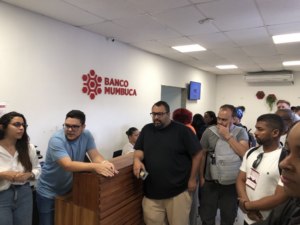
Bank President Manuela Mello (2nd from left) hosting the tour of Banco Mumbuca
As is often the case, the deepest and richest learning of the week came in the field trips. Both field trips took us to Niteroi (also in the state of Rio de Janeiro), Brazilian city founded in 1573 by indigenous chief Arariboia of the Tupi people.
The first stop was the city of Marica, which founded a municipal currency in 2013 in order to spur commerce in what was then considered a “bedroom community” (residents working elsewhere, only going home to sleep). The currency came to life in digital form, through a food stamps platform.In 2015 the city began to receive oil royalties, at which time they increased basic income transfers. That year they also received two displaced indigenous communities, to whom they extended the royalty benefits.
In 2017 the community created Banco Mumbuca and shifted from the food stamp platform to E-dinhero, then in 2025 shifted to a direct contract between the city of Marica and Banco Mumbuca for e-money services. Marica now pays 80 types of basic income benefits for people in a variety of ages and types of hardship, engaging over half of its total population of 200,000.
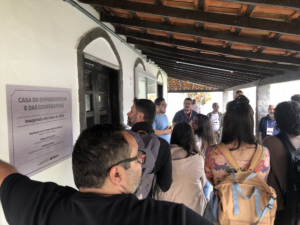
The cooperative entrepreneurship center in Marica
One form of financial sustenance for Banco Mumbuca had been that the e-dinhero platform charges 2% per transaction. A regulatory body later successfully challenged this charge, costing the Bank a primary source of income. This and other conditions led them (like many of the projects and people we heard from) to nearly go bankrupt during the pandemic.
However, the lean times of the pandemic also demonstrated the resilience of the community. People continued to participate and Banco Mumbuca helped to generate jobs and income even in the face of the loss of public funding. Now the city of Marica is providing the space and staffing for Casa Do Empreendedor e das Cooperativas, a community hub that provides legal and administrative back-end services for new enterprises and cooperatives, helping them to obtain legal standing and assistance with capacity building. This is yet another example of how connecting enterprise development and currencies can create new types of opportunities for human-scaled economic development.
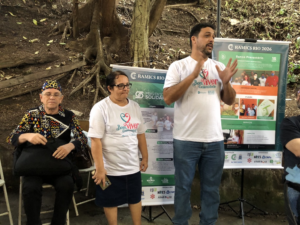
Joaquim Melo (l) with Banco Preventorio leaders Maria Hosana and Dr. Marcos Rodrigues
On our final day of programming we headed back to Niteroi for another two visits.
Banco Preventorio leaders present with Joaquim Melo (l) looking onWe started with Banco Arariboia, the organization behind the municipal-run currency. In 2020 Niteroi established a Solidarity Economy policy with a goal of increasing local production while creating income and jobs for its residents. When covid came, the city provided a basic income for residents, in the form of the currency Moeda Social Arariboia. 50,000 families participated in 2021, then in 2022 it was converted to a permanent program. The municipality created Banco Arariboia to be run by the community. The municipality hosts a store and business incubator space (pictured above) accepting the local currency. Beneficiaries receive a social benefit in the community currency and are able to obtain technical assistance, training, and micro-credit for supplies for their projects or enterprise. The city hosts street fairs where members can exchange their products and services, and the city provides helpful items such as sewing machines, a commercial kitchen, and a projector. All goods sold at the store must be locally produced. Program participants run the street fairs and store/training space.
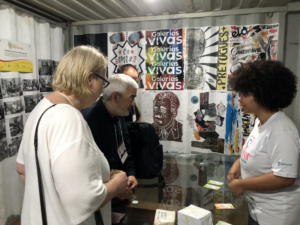
Martina and Julio shop at Banco Preventorio
Lastly, and perhaps mostly, we visited the first community currency project from Niteroi, Banco Preventorio. This was a truly grassroots effort, having begun in 2011 in the local favela – a term which has previously assumed negative connotations, referring to an impoverished Brazilian “slum” – but which is being reclaimed by communities including the one gathered at Banco Preventorio. Their community bank has been offering micro-credit, basic income, and community currency. They have circulated R$300,000 in micro-credit since their inception, typically offering loans and technical assistance for enterprises to start or to level-up. When a member has difficulty repaying the loan they work through it via group practices, whether they choose to create easier repayment terms, partial loan forgiveness, technical assistance in building payment capacity, or other acknowledgement. Now they are giving micro-credit to other communities as well, funding local cooperatives, sewing groups, food businesses and more. These offerings support people to build their business step by step.
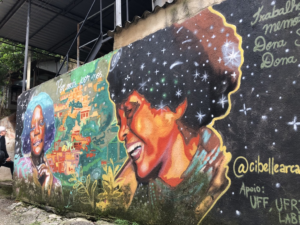
Mural outside Banco Preventorio
Back to the conference presentations. One of the conference’s two prize-winning papers, “Linking Currencies of Time and Local Markets: the Reto Tempolab and the Global Coordination of Networks” by Julio Gisbert Quero, President of Ibero-American Association of Time Banks – ASIBDT, presents yet another call for and approach toward the same types of missing linking that we refer to in our own paper. In short, three pilot projects, two in Spain (Catalonia and Madrid) and one in Costa Rica, will be connecting timebanking with enterprise development and employing hybrid time/Euro transactions in order to create a self-sustaining business and development model. The paper also describes a proposal to create a global alliance of timebank networks to share skills and knowledge.
When I asked conference organizer Eduardo Diniz to report his highlights and main themes of the Portuguese-language-only session that he helped to host, he wrote: “The three experiences share a common understanding that community banks and local currencies are, above all, instruments for territorial strengthening and collective organization rather than merely financial mechanisms. The Cascata Community Bank, the Dabucuri Social Bank, and the proposal for community banks supporting energy transition processes all emphasize the value of local capacities, community participation, and solidarity networks as means of addressing social, economic, and environmental challenges. In each case, social currencies are conceived as tools capable of stimulating territorially embedded economic circuits, strengthening collective identities, and fostering more democratic forms of governance. Furthermore, the three initiatives highlight the importance of collaboration between communities and universities, community banking networks, and large organization in expanding social innovation capacities, albeit in distinct contexts. Together, they point to an evolution of the field of community and solidarity finance in Brazil, increasingly connected to broader agendas of social inclusion, sustainability and territorial development.”
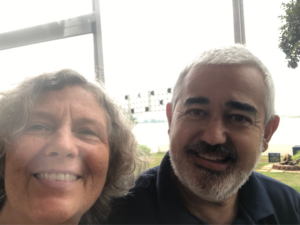
Stephanie and Julio, two of the only timebankers presenting at the event, met by accident during lunch
All of this learning resonates and reflects my own experience with complementary currencies. They can be a powerful tool IF they are implemented to meet community needs, with community governance and participation, based on clearly understood, communicated, and upheld values. They are a means to an end. A design that is inconsistent with the goals and culture of the community can cause more harm than good. And yet, enough people have seen enough benefit and even transformation resulting from different applications of community currencies that we continue to experiment, learn, and share in pursuit of the more beautiful world we believe it’s possible for them to help facilitate.
And yet, in order to realize that dream we need to enact it ourselves, by putting our proverbial money where our mouth is.
Many presenters identified common needs, which could be fulfilled with some concentrated effort, and would benefit from the vast experience represented at the conference. One of the primary needs identified by several presenters is a viable business model for community currencies overall. This was expressed by Nicolas Franka, Michael Marks from the Hudson Valley Current, ourselves in The Missing Linking, and Julio Gisbert who documents several living experiments in connecting timebanking with other economic sectors in his paper (which won the other first prize, see abstracts of mentioned papers here).
Other people expressed a need to make and share “knowledge commons”.
And we heard a need for more path leaders, more of a culture of community, and more honest and up-to-date information about the real state of the field. It was identified that the academic approach romanticizes these systems, while real success emerges from necessity. Academics could also provide assistance to find strengths to build on.
The final session was a meeting of RAMICS where new directors were elected and some others stepped aside. The feeling in the room was triumphant overall, also with a natural sense of fatigue from the big week and all of the work that led up to it.
The primary call to action is for RAMICS to receive proposals for the next international conference in 2 years’ time.
There was also an opportunity to show the yet-to-be-tapped potential of community currency enthusiasts, when one of the organizers made it plain that they felt too burdened with work to create a new avenue of communication to reach a younger audience. I invited RAMICS and its members to join the HUMANs and get someone to help for the benefit of the commons, or for some HUMAN hours, just like we do here in Madison. The time is ripe for us to make life easier for ourselves by asking for help from the multitude of humans around, who are ready to offer it.
I’ll end this write-up with the same quote I used to end my presentation:
“A dream you dream alone is only a dream. A dream we dream together is reality.” – Yoko Ono